


{{serverconnectlatestnews.data.showlatestnews.data[0].news_title}}
{{serverconnectlatestnews.data.showlatestnews.data[0].news_date.formatDate("d MMM yyyy")}}
{{serverconnectlatestnews.data.showlatestnews.data[0].news_teaser}}

The Powder Metallurgy and Additive Manufacturing Laboratory provides advanced facilities for the characterisation of powdered materials and the development of additively manufactured components. The laboratory supports both academic research and industrial collaboration, focusing on the relationship between powder properties, processing conditions and final component performance.
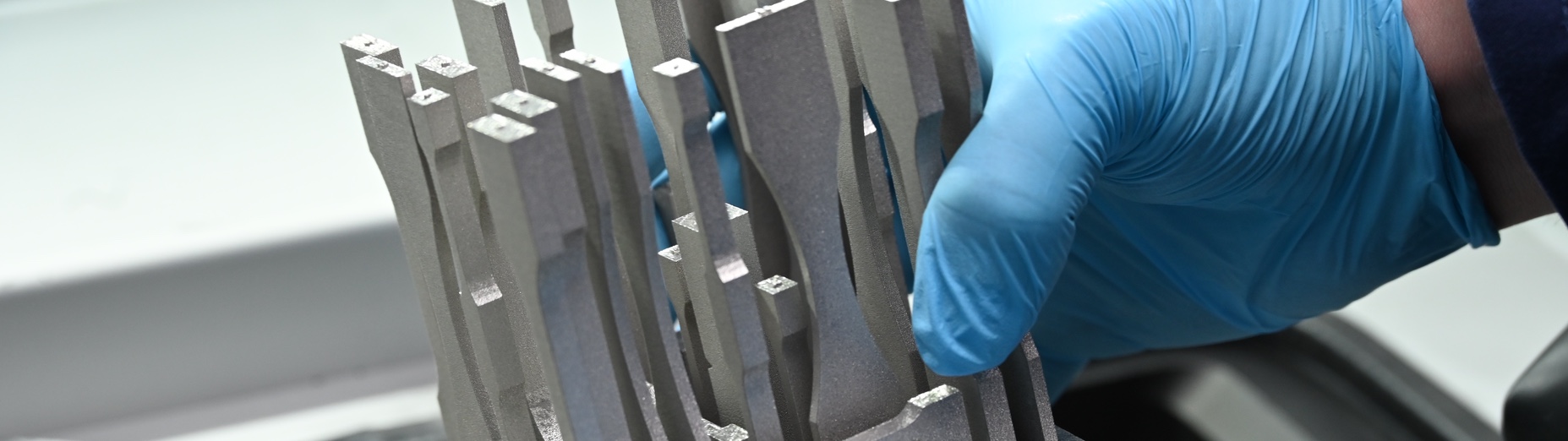
Equipped with state-of-the-art instrumentation, the laboratory enables detailed analysis of powder morphology, particle size distribution, flow behaviour, and compaction characteristics. These insights support optimisation of powder-based manufacturing processes, particularly laser powder-bed fusion (L-PBF) additive manufacturing.
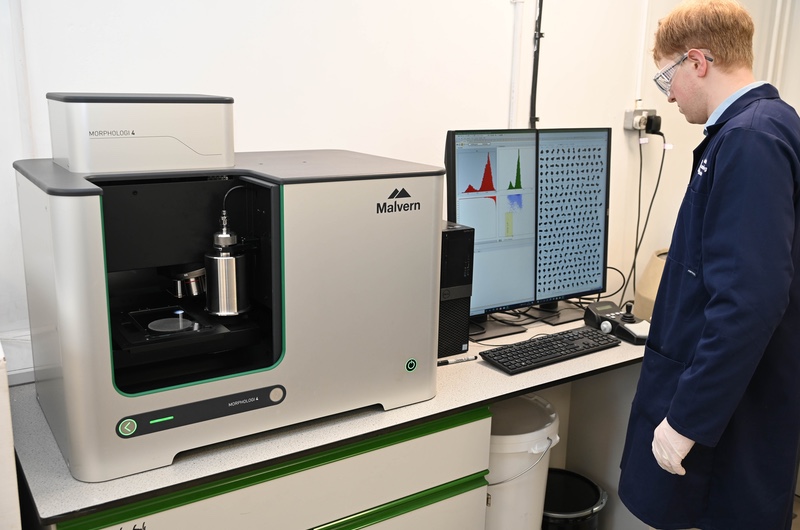
The laboratory specialises in comprehensive characterisation of powdered materials used in powder metallurgy and additive manufacturing processes. Measurements include:
Advanced analytical methods are used to generate quantitative data, enabling data-driven interpretation of powder behaviour and prediction of performance in manufacturing processes.
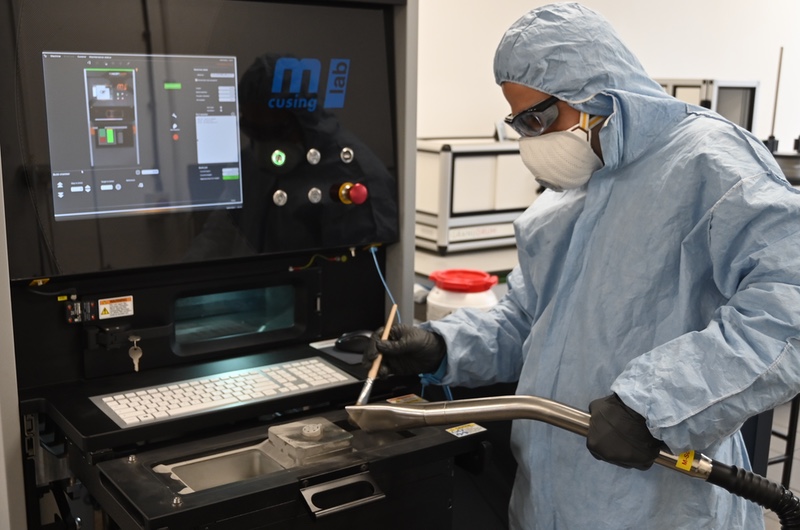
The laboratory supports additive manufacturing using the Laser Powder-Bed Fusion (L-PBF) process. This technique selectively melts layers of metal powder using a high-energy laser to build complex three-dimensional components.
Research focuses on:
The integration of powder characterisation and process development enables a deeper understanding of how powder properties influence print quality and material performance.
The laboratory supports research and development in areas including:
The laboratory provides comprehensive testing of powdered materials used in additive manufacturing and powder metallurgy. Capabilities include:
Particle size distribution and particle shape strongly influence powder flow and packing behaviour. Automated optical imaging systems provide high-resolution analysis of particle morphology and size distribution.
Powder flowability determines how reliably powders spread during additive manufacturing. Dynamic testing methods measure the angle of repose, cohesion, and flow characteristics under rotating conditions.
Apparent density, tap density, and powder compaction behaviour are measured using automated instrumentation compliant with established testing standards.
The laboratory can perform testing compliant with recognised international standards, including:
These tests ensure reliable and reproducible measurement of powder properties used in research and industrial quality control.
Research in the Powder Metallurgy and Additive Manufacturing Laboratory typically follows a structured workflow:
Powder batches are first sampled using a rotating riffle sampler to ensure representative and statistically reliable material selection.
Samples may be sieved to remove oversize particles or contaminants and prepared for analytical testing.
The powder is characterised through:
Experimental data are analysed to understand powder behaviour and identify key parameters affecting manufacturing performance.
Selected powders are processed using laser powder-bed fusion to produce test components under controlled conditions.
Manufactured components are evaluated to determine relationships between powder properties, process parameters and material performance.
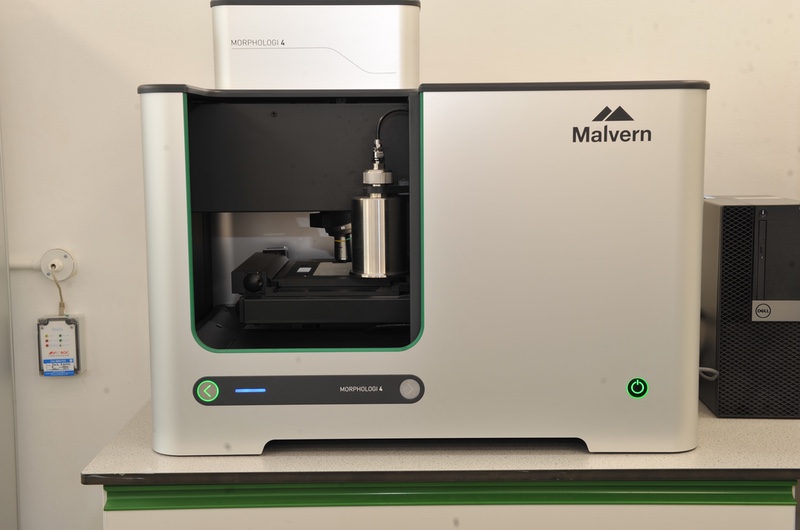
The Morphologi 4-ID is an automated system used for detailed particle characterisation. The instrument disperses powdered samples and captures high-resolution optical images of individual particles to determine:
The system analyses materials with particle sizes ranging from 0.5 µm to 1500 µm.
It is also equipped with Morphologically Directed Raman Spectroscopy, enabling targeted Raman analysis of individual particles to identify chemical composition directly from particle surfaces.
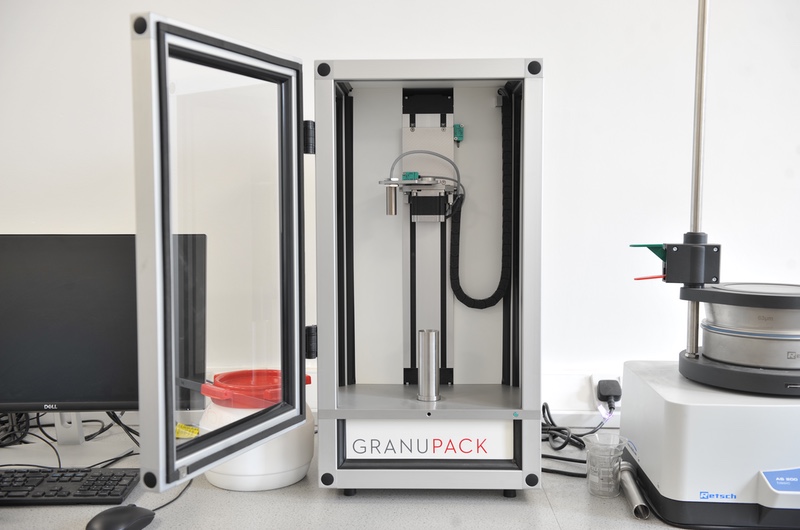
The GranuPack system measures the apparent and tap density of powdered materials using automated and repeatable testing procedures.
Key capabilities include:
The system improves upon traditional methods defined in ASTM B527, while also supporting measurements compliant with the standard.
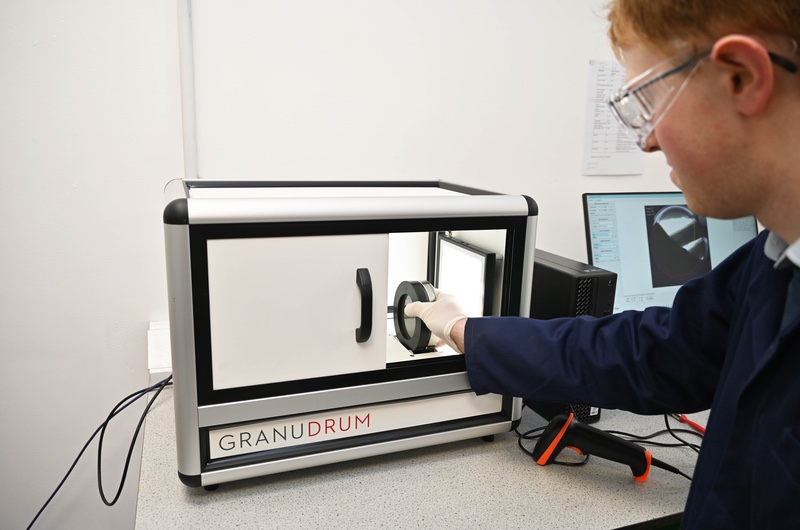
The GranuDrum measures powder flowability using a rotating drum system.
This instrument evaluates:
The dynamic measurement approach provides a more realistic representation of powder behaviour during industrial processing and additive manufacturing.
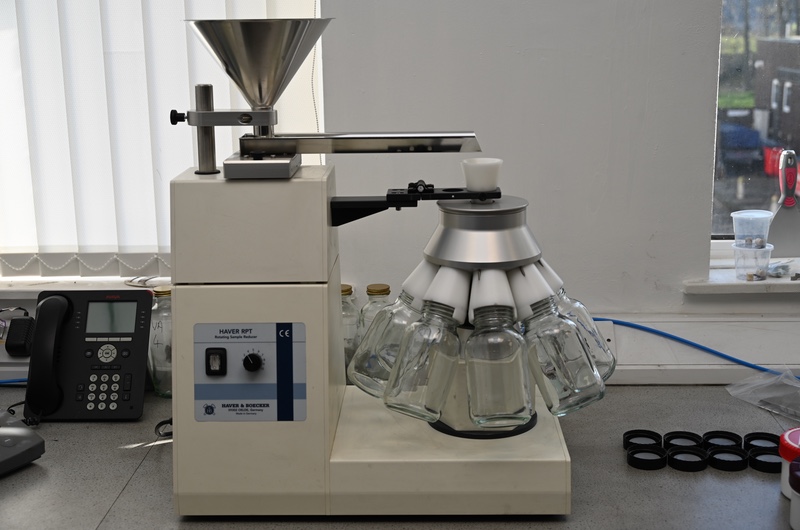
The rotating riffle sampler ensures accurate and representative sampling from larger powder batches.
Representative sampling is essential to ensure reliable and repeatable experimental measurements. The sampling process is aligned with ASTM B215-20.
Laboratory sieves and mechanical sieve shakers are used to classify powders and remove oversized particles or contaminants from powder batches prior to testing or processing.
The Hall Flowmeter is used for standardised measurement of powder flow rate and apparent density using Hall and Carney funnels.
Testing is conducted according to recognised standards, including:
These tests are widely used for qualification of metal powders used in powder metallurgy and additive manufacturing.
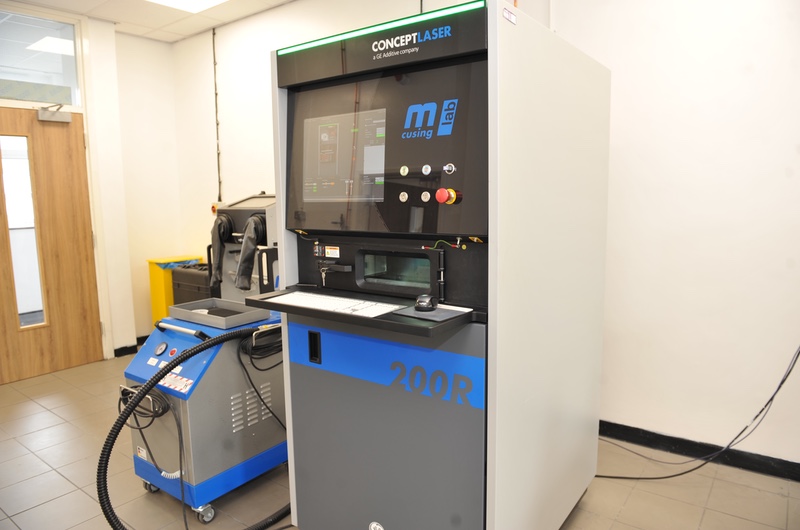
The MLab 200R is a compact laser powder-bed fusion additive manufacturing system designed for research and development of metal additive manufacturing processes.
Key features include:
The system allows investigation of the relationship between powder properties, process parameters, and final component quality.
The laboratory supports a wide range of research topics, including:
Research outputs support both fundamental materials science and industrial process optimisation.
Powder research in this laboratory connects with a range of complementary research capabilities, including:
By integrating powder characterisation with downstream manufacturing and materials analysis, the laboratory provides a comprehensive research platform for powder-based manufacturing technologies.
Enquire about services, facilities, and expertise.
Materials Processing Institute is registered in England with registered No. 08919614
Registered Office: Materials Processing Institute, Eston Road, Middlesbrough TS6 6US
© Copyright Materials Processing Institute
Terms & Conditions / Terms & Conditions of Metal Sales / Website Terms & Conditions / Privacy Policy / Cookies Policy / Data Protection Notice / Site Map
Website by VIA Creative