Metallurgical Investigation - Premature Failure of Water-cooled Ductwork

Metallurgical Investigation  -  Premature Failure of Water-cooled Ductwork

Specialist Equipment

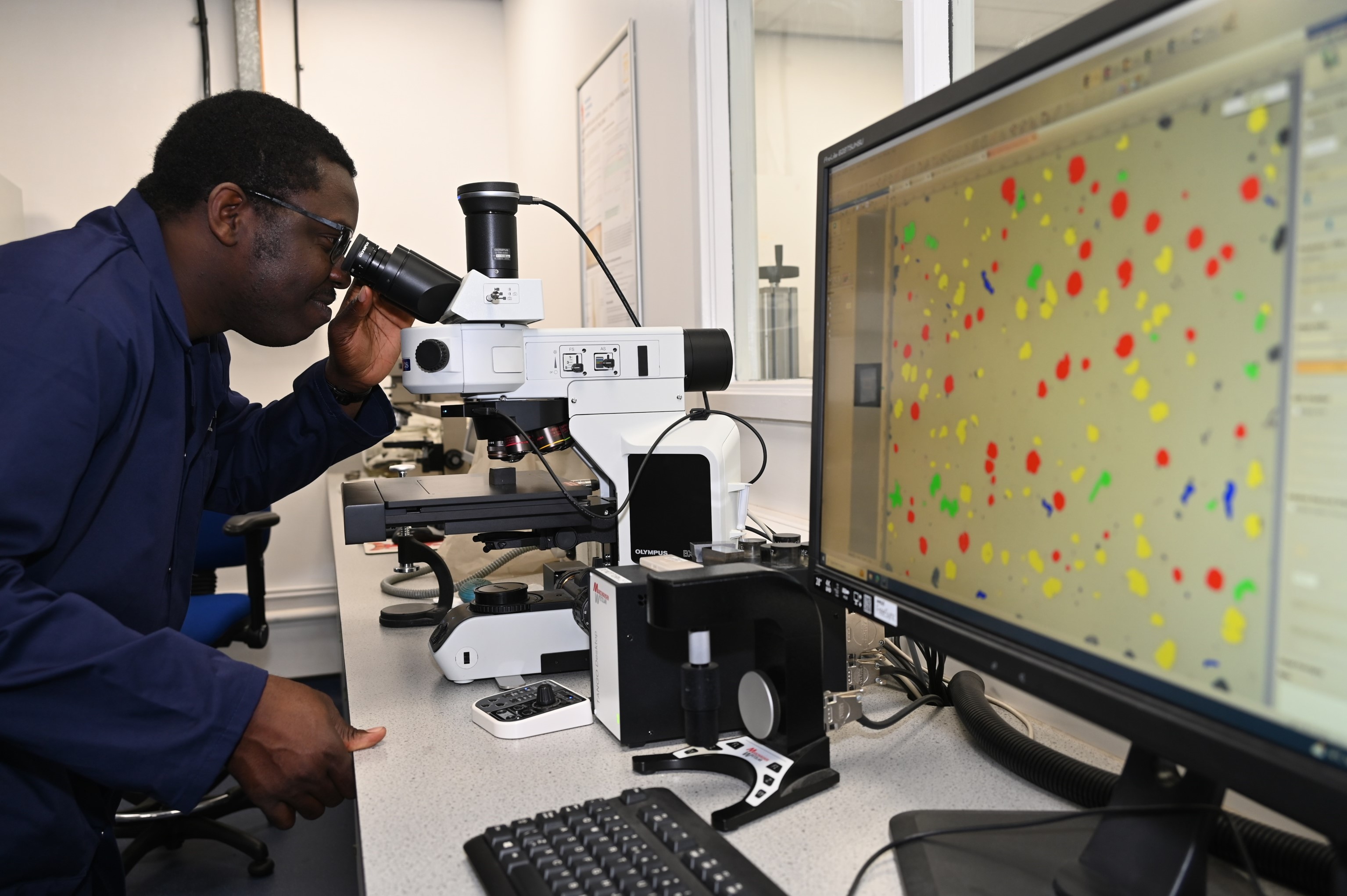
We carry out metallurgical investigations in our Advanced Materials Characterisation Centre using a range of analytical equipment. This includes optical microscopes, providing magnification of up to x1000, and our Scanning Electron Microscopy (SEM), providing high resolution images up to x100000.

Challenge

Our client wanted to understand the cause of cracking and premature failure of water-cooled ductwork and if any of their processing conditions may be contributing to the problem.

This ductwork failure was resulting in stoppages to production while weld repairs were carried out, so it was essential to have a better understanding of why it was happening.
Project Activites

  1. A sample of the ductwork material was examined visually in the as received condition.
  2. The sample was descaled in hydrochloric acid (HCl) to remove oxidised surface material. It was then re-examined and photographed.
  3. Microscopy samples were sectioned in both longitudinal and transverse through thickness section directions. Representative areas of the samples were then photographed using a high-resolution optical microscope, fitted with digital image capture.

Main Observations

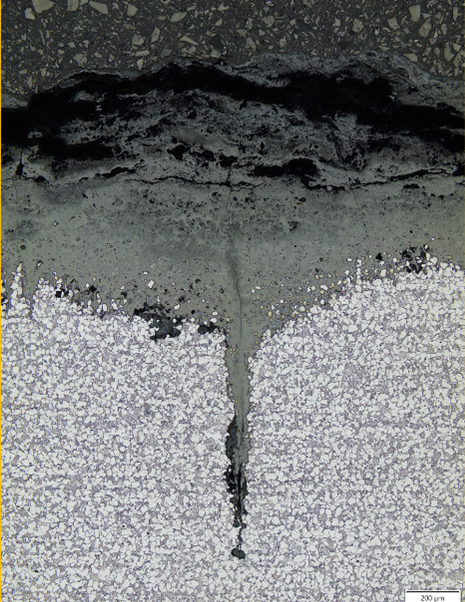
img 1

Ductwork inner wall experiencing surface corrosion and stress cracks
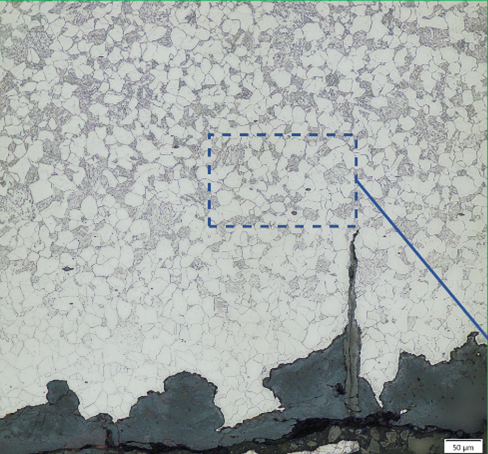
img 2

Outerwall exhibiting surface corrosion, stress cracks and decarb band

This optical microscopy analysis showed:

  • The inner tube diameters were the most highly corroded areas, with evidence of inter-granular corrosion and corrosion pitting along the length of the sample surface.
  • The surface of the tube was very uneven with corrosion fatigue cracks extending through the parent material.
  • The tube walls appeared to have undergone expansion and contraction during heating cycles causing the brittle oxide layer to crack, and opening microcracks through the oxide layer into the metal. The newly exposed metal then oxidises; this then repeats causing the fracture to widen and deepen.
  • The pipework was expanding and contracting in the longitudinal direction resulting in the formation of transverse cracks. This indicates that the pipes were most likely subject to tensile forces from thermal expansion and contraction.
  • As the cracks advanced through the metal the applied stress forces increased and the crack growth accelerated, which can cause internal and external cracks to meet, or single cracks to propagate through the tube wall.

Other Observations

  • Observation of degradation of pearlite in the mild steel may be an indication of long-term overheating (mild steel typically over 450°C).
  • The presence of tubercles within the oxide on the inner tube walls indicates evidence of oxygenated feedwater.
  • Cooling water boiling events can be caused by overheating, blocked ductwork tubes, or if the cooling water is a pressurised system, the loss of pressure will lower the boiling point of water.
  • Events were held to discuss the future research requirements which were added to the roadmap.

Summary

The investigation revealed that the failure was caused by corrosion-fatigue cracking. This was predominately on the inner tube wall of the pipework and exacerbated by the formation of corrosion pits.

Do you want to know more?

Data Protection Notice

Contact the Materials Processing Institute

Enquire about services, facilities, and expertise.

+44 (0)1642 382000

enquiries@mpiuk.com

Contact form